
There are certain projects that feel different from the outset. Not because of their scale or ambition, but because you realize, almost immediately, that you’re not approaching them from the outside. There’s already a connection—something personal that changes the way you see the work before it even begins.
That was the case with the University of Saint Joseph.
I’ve known that campus far longer than I’ve known anything about brand strategy. As a kid, I remember being there without fully understanding why it mattered. It was simply part of the rhythm of our family—familiar, present, and unquestioned. It wasn’t until much later that I began to understand the depth of that connection and what it actually represented.
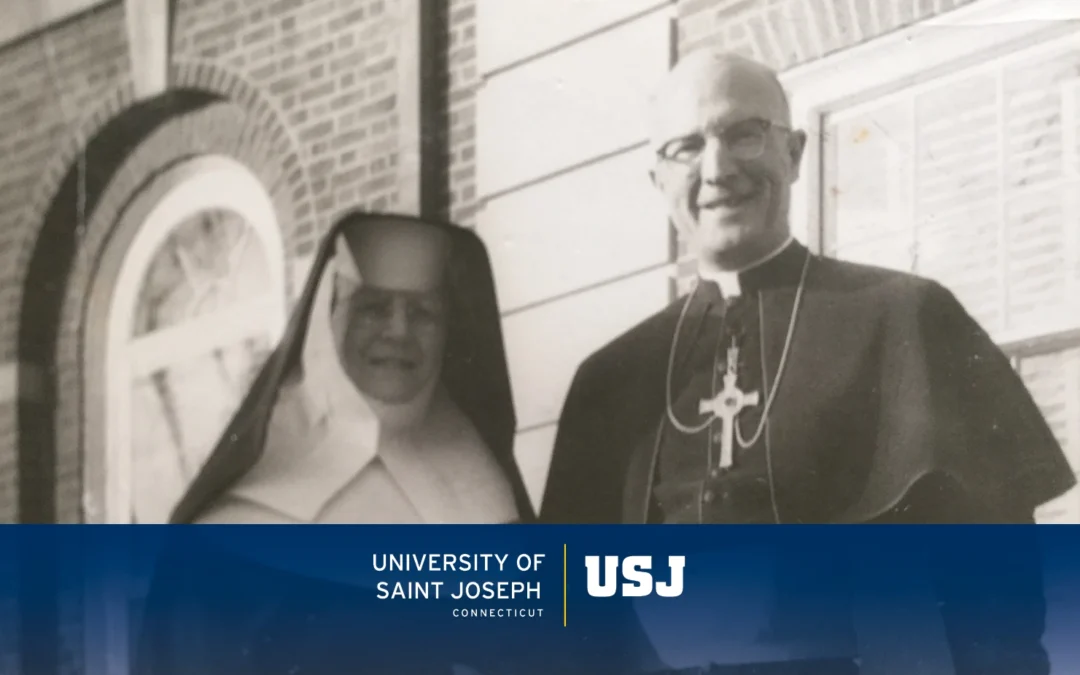
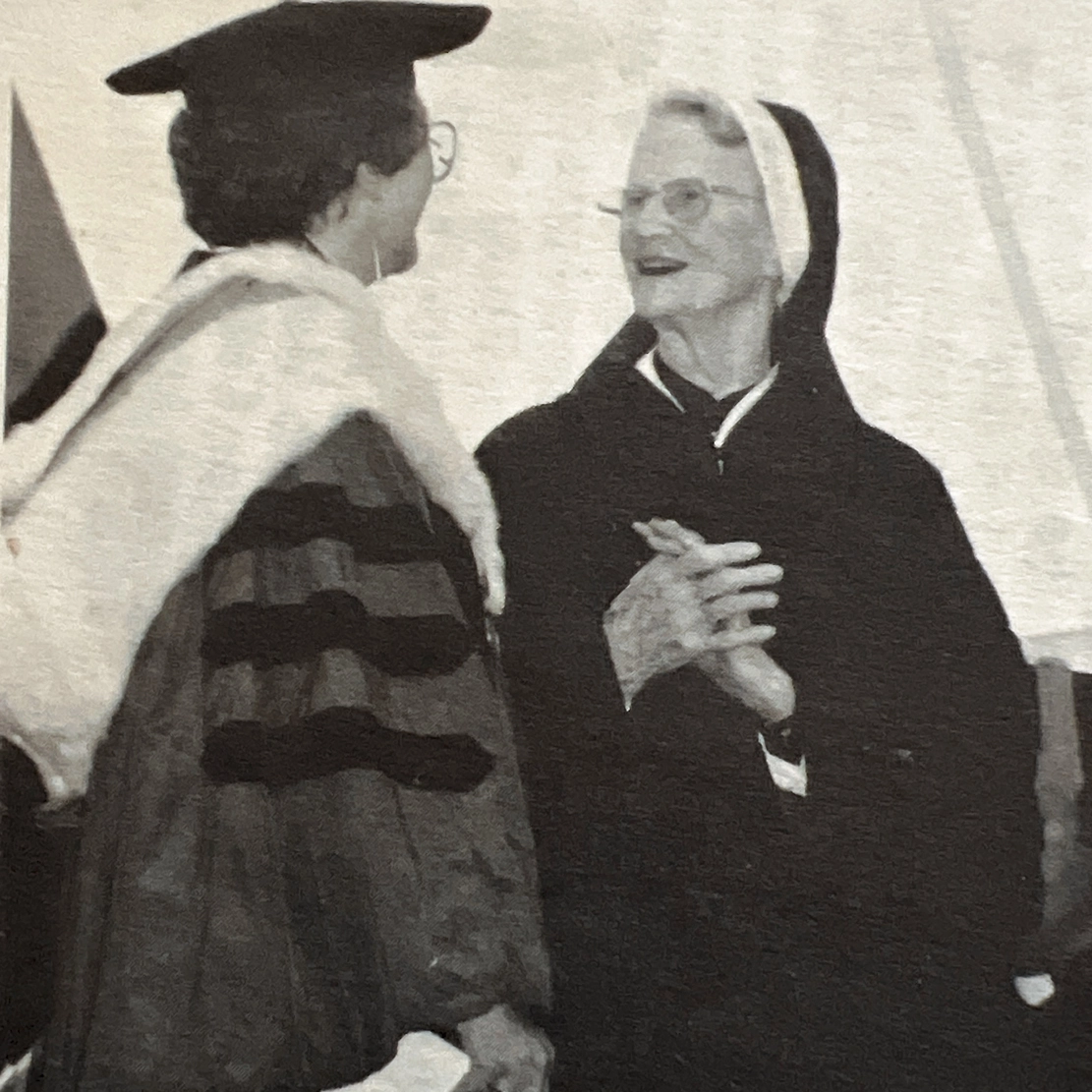
Aside from the fact that my mother was an alum, my great aunt, Sister Joseph Mark McGurkin who we affectionately called “Aunt Alice”, was one of the founding sisters of the school. Her life and her work were not separate from the institution—they were embedded in it. The campus wasn’t just a place she contributed to; it was an extension of what she believed in. That distinction matters, because it shifts the way you think about what an institution truly is.
Recently, I came across a scrapbook that belonged to Aunt Alice. At first, it seemed like a simple collection of memories, but as I spent time with it, it revealed something much more significant. It documented correspondence with her brother, my great uncle, Bishop Edward McGurkin, whose life took him across continents—from the Vatican, Africa and in China, where he was imprisoned during World War II, and eventually back to the United States. Despite the distance, the hardship, and the vastly different contexts they operated within, there was a consistency in their writing that stood out. The same sense of purpose. The same clarity of belief. The same commitment to something beyond themselves.
That consistency is what stayed with me.
Because when you step back and look at the founding of the University of Saint Joseph, you begin to see that it wasn’t created in response to a market opportunity or a competitive landscape. It was built as an expression of a deeply held belief system—a commitment to educating the whole person, to service, to community, and to creating something that mattered beyond individual achievement. That kind of origin is not something you can manufacture, and it’s not something that fades easily over time.
When we began the brand positioning and campaign work, there was a natural temptation to approach it the way we often do. To analyze the competitive set, identify points of differentiation, and construct a narrative that would help the University stand out in an increasingly crowded and transactional higher education landscape. That process is typically informed by the kind of deep database analysis we rely on—looking at behavioral, demographic, and psychographic insights to better understand what drives decision-making and where opportunities exist to connect. But even with that level of insight, the approach still assumes that the answer needs to be created.
At USJ, it didn’t.
It needed to be recognized.
The work led us back to a set of truths that had been there all along. This is a place where students are prepared for real-world success, but not at the expense of who they are becoming. It is an environment shaped by values—compassion, integrity, and a responsibility to others—that guide not just academic outcomes, but personal ones as well. Students leave with the ability to build careers, but also with a sense of purpose that informs how they use those careers in the world.
That balance—between ambition and empathy, between achievement and service—is not common, and it is not new.
It is foundational.
The strategic framework we developed gave language to that idea through pillars like Belonging, Becoming, Thriving; The Mercy Path; and Real-World Successes. Each of them articulates a different dimension of the same underlying truth, reinforcing that the University is not defined by any single attribute, but by the integration of all of them.
From that foundation, we arrived at a clear positioning, one that ultimately shaped the campaign idea “For Good.” At its core was a simple but powerful truth: educated to do well, empowered to do good. It connected values with outcomes in a way that felt both authentic and enduring. Whatever path students choose, they pursue it not only for their own success, but for something larger—for their communities, for the people they serve, and for the impact they will have over time.
What made it resonate wasn’t its originality. It was its accuracy.
It reflected something that had been present long before we arrived.
That realization is what continues to stay with me. Not the process, not the deliverables, but the understanding that the most meaningful work we do is rarely about invention. It is about clarity. It is about seeing what already exists and giving it the structure and language it needs to be understood by others.
I think back to that scrapbook and the lives it captured. The distance between continents, the challenges faced in entirely different parts of the world, and yet the same core belief holding everything together. And then I think about the campus in West Hartford, which operates in a completely different context but is rooted in the same idea.
Different expressions. Same foundation.
We spend a great deal of time in our industry trying to define brands—to shape them, refine them, and position them in ways that make them distinct. But occasionally, you encounter something that resists that process, not because it lacks clarity, but because it already possesses it.
The University of Saint Joseph was never a blank canvas.
It was, and continues to be, a legacy.
And the role of the work was not to create that legacy, but to make sure it could be clearly seen, understood, and carried forward.